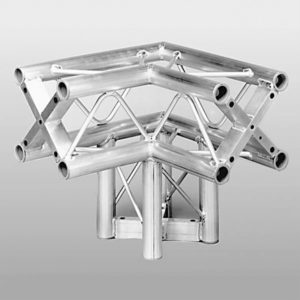
SC Pro ST Square Trussing
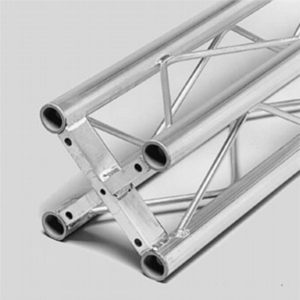
SC Pro ST Square Trussing is a purpose-built, square-profile framework widely specified for stage, touring, and installation projects. Each section is milled, welded, and checked to tight tolerances, giving designers repeatable results when constructing overhead grids or ground-supported structures. Neither excessive weight nor bulky joints hinder the system, so crews can build robust runs, towers, and elaborate layouts without resorting to specialised handling equipment.
Core Structure and Materials
A four-chord arrangement sits at the heart of every piece, creating uniform load paths down each edge. Diagonal bracing connects the chords, reducing flex and keeping deflection within predictable limits on longer spans. The alloy selected for production mixes low mass with high tensile strength, helping to keep moving loads under control while remaining comfortable to lift by hand.
- Four equal chords positioned on each corner for balanced loading
- Internal diagonals set at calculated angles to limit twist
- Heat-treated weld zones for additional fatigue resistance
- External surfaces cleaned and finished to discourage corrosion
Connection Method
Sections link together with conical fittings, pins, and retaining clips. The tapered fit removes play once the pin is locked, so alignment remains true throughout the run. Because the hardware is industry-standard in size, spare parts and additional fittings are simple to source. Crews appreciate that no fixed orientation is required; the square profile lets any face serve as the top or the side without compromising capacity.
Segment Length Options
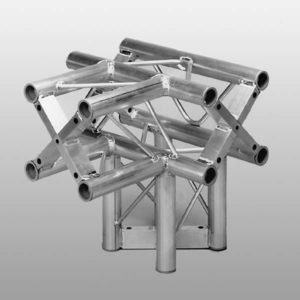
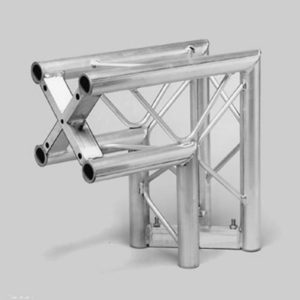
Stage Concepts keeps a consistent range of straight pieces in stock, typically from 0.5m up to 4.0m. Corner cubes, T-sections, and cross-blocks extend the catalogue, allowing rigs to turn, branch, or drop vertically without bespoke fabrication. Larger builds therefore become a matter of combining catalogue parts rather than commissioning one-off items.
Typical Roles on Site
The modular nature of SC Pro ST Square Trussing lends itself to a broad set of duties. Common tasks include:
- Supporting moving head fixtures, follow spots, strip lights, and projection housings above a stage line
- Framing scoreboards, LED screens, or scenic flats in venues with limited fixing points
- Forming cable bridges to keep power and data lines out of the performance area
- Creating self-climbing towers for line-array loudspeakers or delay hangs during outdoor shows
Because the design shares a single profile across every part, weight calculations made for one layout generally apply to others, simplifying advance paperwork. Integrators therefore quote more confidently and cut down on site revisions.
Assembly Sequence
- Lay sections on padded ground cloths in build order. Verify connector faces are clear of burrs or grit.
- Insert a conical sleeve between adjoining chords. Tap gently until flush, then locate the main pin through the aligned bores.
- Secure with the supplied R-clip or safety nut, depending on the pin style.
- Work from the centre of the run toward each end to minimise accumulated error.
- Once the frame is full length, lift with chain hoists or manual stands, observing the load map to keep angles within limits.
A competent person should always sign off before lifting any rig into its final position. Instruments and scenery go on only after the frame has passed that check.
Integration with Venue Equipment
Standard tube diameters let lighting clamps, half couplers, and trigger clamps grip firmly without adapters. For loudspeaker frames, manufacturer-approved brackets bolt directly through bracing nodes. Power-daisy chains and DMX looms clip to the lower chords, keeping the upper face free for fixture movement. Where a broadcast camera line is needed, tensioned cable saddles span diagonally across two faces, creating a protected lane away from follow-spot operators.
Custom Truss Work
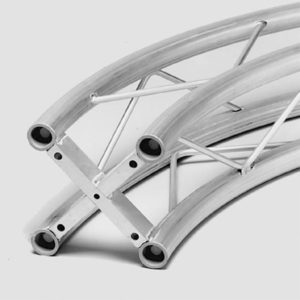
Special layouts such as circles, ovals, or uneven polygons are built from pre-cut angles or one-off elbows. Stage Concepts provides line drawings for sign-off, then machines each joint to marry seamlessly with catalogue parts. Lead times vary with complexity, though common angles (30, 45 and 60 degrees) remain in limited stock for quick dispatch.